2026 College Fantasy Football QB Rankings: The Comprehensive Guide
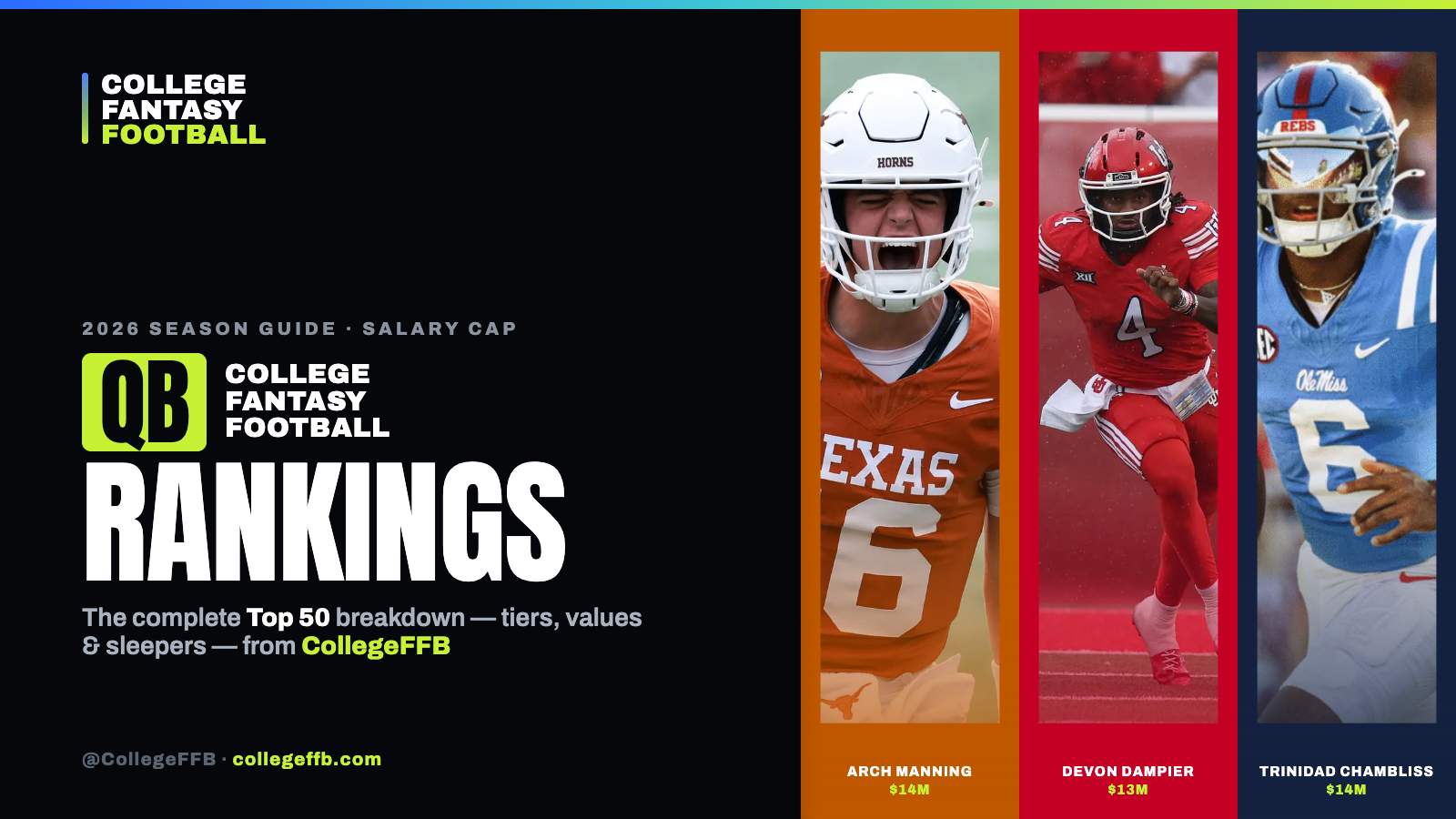
This is all 50 quarterbacks worth knowing for 2026, and they are not all the same kind of player.
There are the elites, the handful at the top who score every way there is to score and cost what they should. There are the safe floors, big arms attached to great offenses who will throw for 3,500 and run for nothing, and who are worth exactly as much as you think and no more. There are the projects, the five-stars and the freshmen and the transfers who haven't locked down a job yet but could be the best player on this list by November. And there are the diamonds in the rough, the guys buried at the bottom of the board who ran for double-digit touchdowns last year and cost $6M.
We break down all of it.
One thing to keep in mind the whole way through: rushing is the separator. Real-life value and fantasy value are not the same thing here. A quarterback who throws for 3,600 and runs for nothing is a very good football player and a middling fantasy asset. A quarterback who throws for 2,700 and runs for 700 with double-digit rushing scores is a machine. That single fact explains why a Heisman finalist sits at 19 on this list and why the guy at 40 might win you the season.
Prices below are what each quarterback costs in CollegeFFB. The tiers move roughly with price, and the whole point is finding the spots where the price and the projection don't match. Here's the board, 1 through 50.
The Top 10
This is the group you're building around. Nine of the ten offer a rushing floor, which is not an accident.
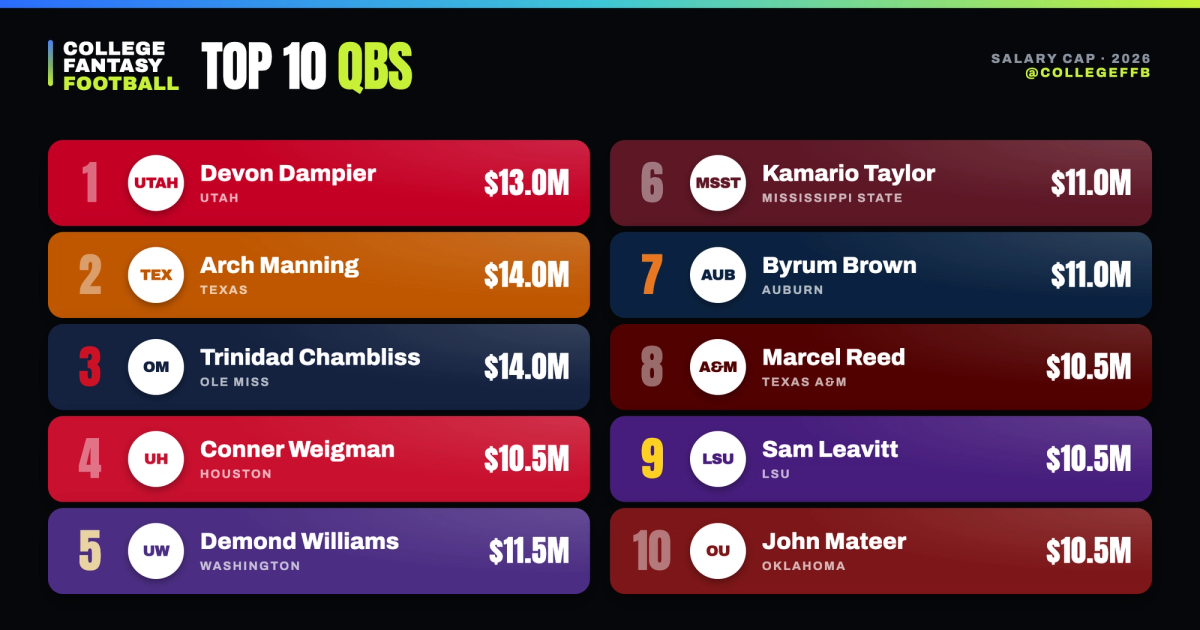
1. Devon Dampier, Utah ($13.0M). The favorite, and it isn't especially close for a rushing-scoring format. Dampier went 2,490 and 24 through the air with just 5 picks in his first Power 4 season, then added 835 yards and 10 scores on the ground. That's a 34-touchdown floor with a runner who carries the offense, not a guy who vultures the occasional sneak. He also draws the friendliest schedule of anyone up here, running it back in the Big 12 while Manning and Chambliss spend their falls in the SEC. Cheaper than both of them, too. Easy QB1.
2. Arch Manning, Texas ($14.0M). If you're paying $14M for Arch, you're buying the integral piece of what might be the most talented offense in the country by a mile. His first full year was already real: 3,163 yards, 26 touchdowns, 7 picks, a 10-3 finish and a Citrus Bowl win, plus 10 rushing scores that hand you goal-line equity most pocket passers can't touch. Then look at the additions. Cam Coleman arrives from Auburn as the top player in the portal, a second WR1 across from Ryan Wingo. The backfield went from a question mark to arguably the best in the country with Raleek Brown and Hollywood Smothers, a first-team All-ACC back who led his conference in rushing per game. The bet is that Arch takes the next step and buries the question of whether the hype was ever about the talent or the last name. At full price, that's the ceiling you're paying for, and it's a real one.
3. Trinidad Chambliss, Ole Miss ($14.0M). The best story in the sport is back after winning his eligibility case in court. All he did in 2025 was throw for 3,937 with a 22-to-3 touchdown-to-pick ratio, run for 527 and 8 more, and drag a Ferris State transfer story to the Playoff semis. The nuance for 2026: Kiffin's gone, Pete Golding runs the show now, and the offense reshapes around Kewan Lacy in the backfield. The floor is high and the ball security is absurd. You're just paying full freight while the staff turns over.
4. Conner Weigman, Houston ($10.5M). The value of the entire board, and it's not close. Weigman is a top-four fantasy QB priced like the guys at 8, 9 and 10. In his first year at Houston he went 2,711 and 25 through the air and added 700 yards and 11 touchdowns with his legs. That's 36 total scores from a genuine dual-threat, and the roster got better. Amare Thomas is back after a 966-yard, 12-touchdown season that put him second in the Big 12, and Houston added Makhi Hughes, who ran for over 1,300 yards twice at Tulane. Outside the top three, he's the best passing-and-rushing mix on the board and he costs $10.5M. Take the discount.
5. Demond Williams, Washington ($11.5M). Led the Big Ten in total offense as a sophomore and it barely got talked about. Williams completed nearly 70 percent for 3,065 and 25 scores, threw only 8 picks, and chipped in 611 and 6 on the ground. Fisch's offense is built for him and he re-signed after a 48-hour portal scare Husky fans have chosen to forget. Fair price, safe floor, real upside.
6. Kamario Taylor, Mississippi State ($11.0M). A bet on the runner, and what a runner. Taylor took over late as a true freshman and closed the year by going for 173 on the ground in the Egg Bowl. He's 6-4, 230, and ran for over 1,200 yards in high school. The passing is unproven at the SEC level and the sample is tiny, so this is a projection. But the rushing upside is the kind that wins weeks by itself, and he's the full-time starter now.
7. Byrum Brown, Auburn ($11.0M). If you only read last year's stat line, Brown might be underpriced here. He led all of FBS in total offense in 2025: 3,158 passing, 28 touchdowns, and 1,008 rushing with 14 more scores at USF. That's 42 total touchdowns and one of the rare 3,000/1,000 seasons anyone's ever put up. He follows Alex Golesh to Auburn and runs the exact same system with several old teammates. The only question is whether it travels to the SEC. The rushing floor says you don't have to wait around to find out.
8. Marcel Reed, Texas A&M ($10.5M). Reed ran the Aggies to an 11-0 start and the program's first Playoff appearance, and he's a legit dual-threat: 3,169 and 25 through the air, 493 and 6 on the ground. The knock is turnovers. He threw 12 picks and closed with four in his final two games and no touchdowns, and now he's breaking in new coordinator Holmon Wiggins. The rushing keeps him worth rostering. The variance is real.
9. Sam Leavitt, LSU ($10.5M). Pure ceiling. When healthy in 2024 he threw for 2,885 and 24, ran for five more, and won a Big 12 title. His 2025 ended after seven games and foot surgery. Now he's the No. 1 portal QB running Kiffin's offense at LSU, and every report has him fully cleared. The talent is QB1 in this class. The only thing keeping him this low is the durability track record, and that's fair to hold against a guy who just lost most of a season to his lower body in a fantasy format where rushing dominates.
10. John Mateer, Oklahoma ($10.5M). Same story as Leavitt, different body part. Mateer walked into 2025 as a Heisman favorite, started 4-0 with wins over Michigan and Auburn, then broke his throwing thumb and was never the same, limping to a 14-to-11 touchdown-to-pick line while still adding 431 and 8 with his legs. He says the hand's at full strength and he's rebuilt his throwing motion. If the healthy version shows up, he's a top-five fantasy QB. That's a real if, which is why he's the last name here and not higher.
Tier 2: Floor and a Ceiling (Nos. 11-20)
Starters you can plug in and not worry about. Most have a proven floor and a path to a top-ten week.
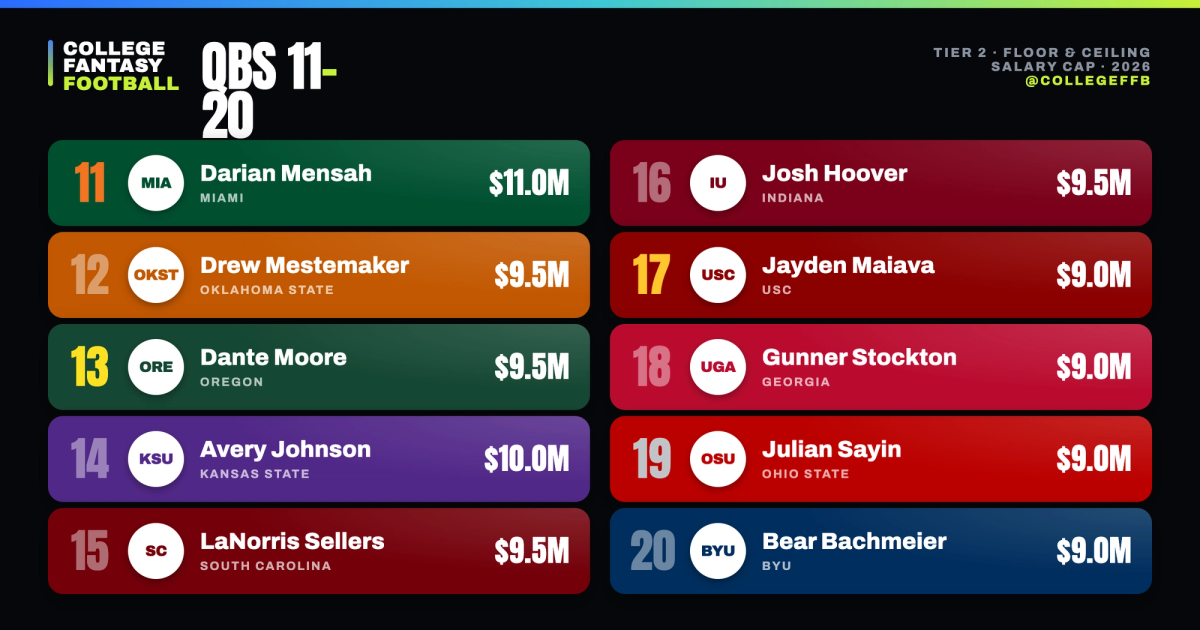
11. Darian Mensah, Miami ($11.0M). Led the ACC with 3,973 yards and 34 touchdowns against just 6 picks at Duke, broke the program's single-season records, and won the league title. Now he's Miami's third straight portal QB1 after Cam Ward and Carson Beck, and he brought his best receiver with him in Cooper Barkate, who went for 1,106 and 7. The one thing to know for this format: he barely runs. It's elite, high-volume, low-turnover passing production and nothing else. Mensah might be a top-4 real-life QB, and I wouldn’t be surprised if he puts up some stupid large numbers with Toney and Barkate, but to start the year I’d have a hard time taking him over some of the similarly priced options above him.
12. Drew Mestemaker, Oklahoma State ($9.5M). The value play of this tier. Mestemaker was a walk-on who became the FBS passing leader in 2025, throwing for 4,379 yards and 34 touchdowns and winning the Burlsworth Trophy at North Texas. He follows head coach Eric Morris and a dozen-plus teammates to Oklahoma State to run the same Air Raid, and Air Raid means volume, and volume means points. The catch is competition: he didn't face a single Power 4 defense last year, and now he opens against Oregon and a full Big 12 slate. But of the G5-up transfers, he's the one analysts keep tagging for a Mendoza-style jump. At $9.5M, the passing floor alone plays.
13. Dante Moore, Oregon ($9.5M). Turned down a possible top-two pick to come back, which tells you what he thinks of the Oregon situation around him. He completed 71.8 percent for 3,565 and 30 scores and took the Ducks to the Playoff semis. The fantasy limiter is stark: 156 rushing yards and 2 scores on the ground all year. You're buying elite efficiency and a great supporting cast with almost no rushing kicker. Safe, capped.
14. Avery Johnson, Kansas State ($10.0M). The dual-threat profile is exactly what this format wants, but be honest about the trend. His 2024 (2,712 and 25 passing, 605 and 7 rushing) was better than his 2025 (2,385 and 18 passing, 477 and 8 rushing) as K-State fell to 6-6. Still one of only nine Power 4 quarterbacks to throw 18-plus and run for 8-plus, and Collin Klein is now the head coach. The rushing floor is real; the passing needs to bounce back to justify $10M.
15. LaNorris Sellers, South Carolina ($9.5M). Read this one carefully, because the reputation and the 2025 tape don't match. Sellers is 6-3, 240 with legitimate speed, and in 2024 he ran for 674 and 7. In 2025 that cratered to 270 and 5 behind one of the worst offensive lines in the Power 4, and the passing slid too (2,437, 13 touchdowns, 8 picks) as South Carolina went 4-8. The bet is on the reset: Kendal Briles arrives from TCU as offensive coordinator with a new line coach, and Sellers closed the year with 901 yards and 6 scores over his final three games. Bounce-back upside, but you're not buying last year's rushing floor because it wasn't there.
16. Josh Hoover, Indiana ($9.5M). Read the situation before you read the player. Hoover is the leading returning passer in college football, with nearly 10,000 yards and 71 touchdowns across four years at TCU, including 3,472 and 29 last season. Now he inherits the Indiana offense that just produced a Heisman winner and a national title under Curt Cignetti. That's the best passing situation on this list. The flags are that he doesn't run and he turns it over, 13 picks last year and 33 for his career. In fantasy, the lack of legs is why he's here and not higher, but the volume and the system make him one of the safest passing floors you can buy at $9.5M.
17. Jayden Maiava, USC ($9.0M). Quietly one of the best values in this tier. Maiava led the Big Ten with 3,711 yards and added 24 passing scores plus 6 rushing touchdowns, 30 total, while posting the best QBR in the country. He's back for a senior year in Lincoln Riley's offense. The caveat is the receiver room, which loses Makai Lemon and Ja'Kobi Lane to the draft. Even so, top-of-conference volume with a half-dozen goal-line runs mixed in is a strong profile at $9.0M.
18. Gunner Stockton, Georgia ($9.0M). The most underrated name in this tier for fantasy. Stockton finished seventh in Heisman voting with 2,894 and 24 through the air against 5 picks, and then ran for 462 and 10 more. He led Georgia in rushing touchdowns, the first Bulldog quarterback to do that since 1942. That's 34 total scores from a guy priced at $9.0M. The passing volume is modest by design (Georgia throws a ton of it at or behind the line), so his yardage will never wow you. The touchdown equity is what you're buying, and there's a lot of it.
19. Julian Sayin, Ohio State ($9.0M). Here's the fantasy paradox in one player. Sayin threw for 3,610 and 32, led the nation in completion percentage at 77.0, and finished fourth in the Heisman voting. He also finished the regular season with negative net rushing yards and zero rushing touchdowns. He is a better college quarterback than almost everyone above him and a worse fantasy asset than several guys below him. Elite, safe, entirely capped.
20. Bear Bachmeier, BYU ($9.0M). The last name in this tier is one of the better values in it. As a true freshman, Bachmeier threw for 3,033 and ran for 527 with a BYU-record 11 rushing touchdowns, tied for the Big 12 lead among quarterbacks, and dragged the Cougars to 12 wins and the conference title game. He returns with the same coordinator, the same system, and the playbook fully opened up. The passing touchdown total (15) is the growth area, but the rushing floor is already elite and he's only going to throw it more. At $9.0M, that's a steal.
Tier 3: The Value Board (Nos. 21-29)
Everyone here is $7M to $8.5M. The tier splits cleanly into high-volume passers with no legs and dual-threats with unproven arms. Know which one you're buying. (We already wrote a full article about some of out favorite values at QB in CollegeFFB if you want to check that out)
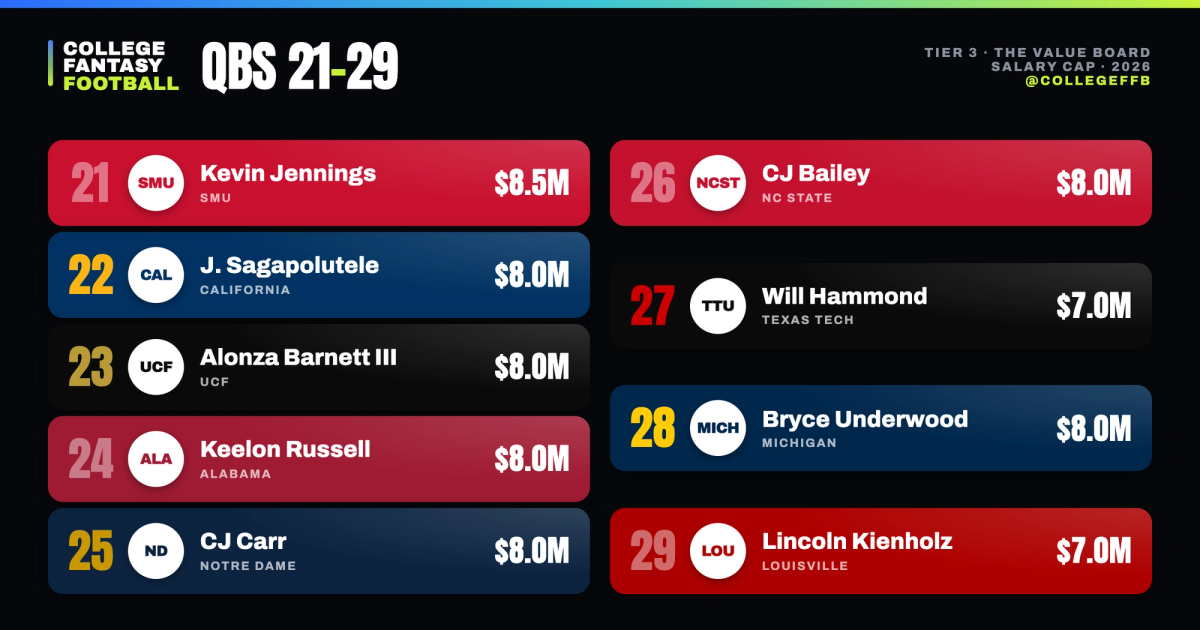
21. Kevin Jennings, SMU ($8.5M). Some analysts called him the most underrated quarterback in the country entering 2026, and the passing profile backs it: 3,648 yards and 26 touchdowns while leading SMU to the Playoff. The thing to know for fantasy is that his rushing cratered last year, from 354 yards the season before down to 54. The mobility is real but it's escape-the-rush mobility, not designed-run production, so he scores through the air or not at all. High passing volume, turnover risk (13 picks), limited rushing floor. Fantastic value. Same floor as the names in the tier above. Lower cost. That’s the play.
22. Jaron-Keawe Sagapolutele, California ($8.0M). Say the name once and you'll remember it. As a true freshman he threw for 3,460 and 18 and finished the year without an interception in his final 178 attempts, the kind of ball security that gets compared to Jared Goff's Cal freshman year. New coach Tosh Lupoi flew to Hawaii to keep him. The knock for this format is the same as Jennings: he's a passer, not a runner, with only four rushing scores. High floor through the air, minimal rushing kicker, and a year of continuity should push the counting stats up. Good value at $8.0M.
23. Alonza Barnett III, UCF ($8.0M). Perhaps one of the most mispriced players on this board. Barnett won Sun Belt Player of the Year and took James Madison to the Playoff by throwing for 2,806 and 23 and running for 589 and 15 touchdowns. That's 38 total scores, fifth nationally in points responsible for, and it came a year after tearing his ACL. Fifteen rushing touchdowns is top-five-QB production in this format, and he's priced in the value tier. The risk is the level-up to the Big 12 and a UCF program that has cycled through seven starters in two years under Scott Frost. Take the swing anyway.
24. Keelon Russell, Alabama ($8.0M). Enormous talent, unsettled job, but widely expected to be the starter. Russell was a five-star, the Gatorade National Player of the Year, and he outplayed Austin Mack in the spring game (four touchdowns on A-Day). He has also thrown 15 career passes. Alabama has not named a starter, and Kalen DeBoer has publicly cautioned against reading too much into the spring. If Russell wins it, the talent, the legs, and the weapons make $8.0M look cheap.
25. CJ Carr, Notre Dame ($8.0M). A genuinely excellent redshirt freshman season: 2,741 yards, 24 touchdowns, 6 picks, fifth nationally in passing efficiency, and he's a popular 2026 Heisman pick. For fantasy the profile is narrow, though, 33 rushing yards on the year with 3 short scores, and Notre Dame loses Jeremiyah Love, who finished third in the Heisman voting. Stable floor, high passing ceiling, no rushing. Similar to Julian Sayin, but $1M cheaper.
26. CJ Bailey, NC State ($8.0M). Better than his price. The 6-6 junior threw for 3,105 and 25 with a 69 percent completion rate and added 215 yards and 6 touchdowns on the ground, 31 total scores. He's a two-year starter who chose to run it back. The concern is the supporting cast, since NC State graduates a chunk of his receiving production. Solid dual-threat value at $8.0M.
27. Will Hammond, Texas Tech ($7.0M). A genuine sleeper. In limited time behind Behren Morton in 2025, Hammond went for 680 passing yards and 7 touchdowns and added 299 yards and 5 scores on the ground, the most rushing by a Texas Tech quarterback in years, before an ACL tear ended his season in October. He's the projected 2026 starter on a loaded, portal-flush Texas Tech team with real playoff aspirations. The knee is the flag, and he missed spring, but he was throwing and running by May. Dual-threat production on a strong offense at $7.0M is exactly the kind of swing this tier is for.
28. Bryce Underwood, Michigan ($8.0M). The freshman year was uneven (2,428 yards, 11 touchdowns, 9 picks, 60.3 percent), but two things point up. His receivers dropped 29 passes; catch those and his completion rate is near 69 percent. And he already ran for 396 and 6 touchdowns as a true freshman. Now Michigan hands the offense to new coordinator Jason Beck, whose Utah unit last year finished second nationally in rushing, the same system that produced Devon Dampier. A quarterback with Underwood's legs in Beck's offense is a real Year 2 leap candidate.
29. Lincoln Kienholz, Louisville ($7.0M). A three-year Ohio State backup who finally gets the keys, this time in Jeff Brohm's quarterback-friendly Louisville offense that just got 2,679 and 16 out of Miller Moss. Kienholz is athletic and was used in short-yardage at Ohio State, so there's a rushing element, but the starting sample is basically nonexistent, 36 career pass attempts. This is a bet on the system and the traits, not the résumé. At $7.0M, that's a fair bet.
Tier 4: Swing for Upside (Nos. 30-37)
Boom-or-bust bench territory, $6.50M to $8M.
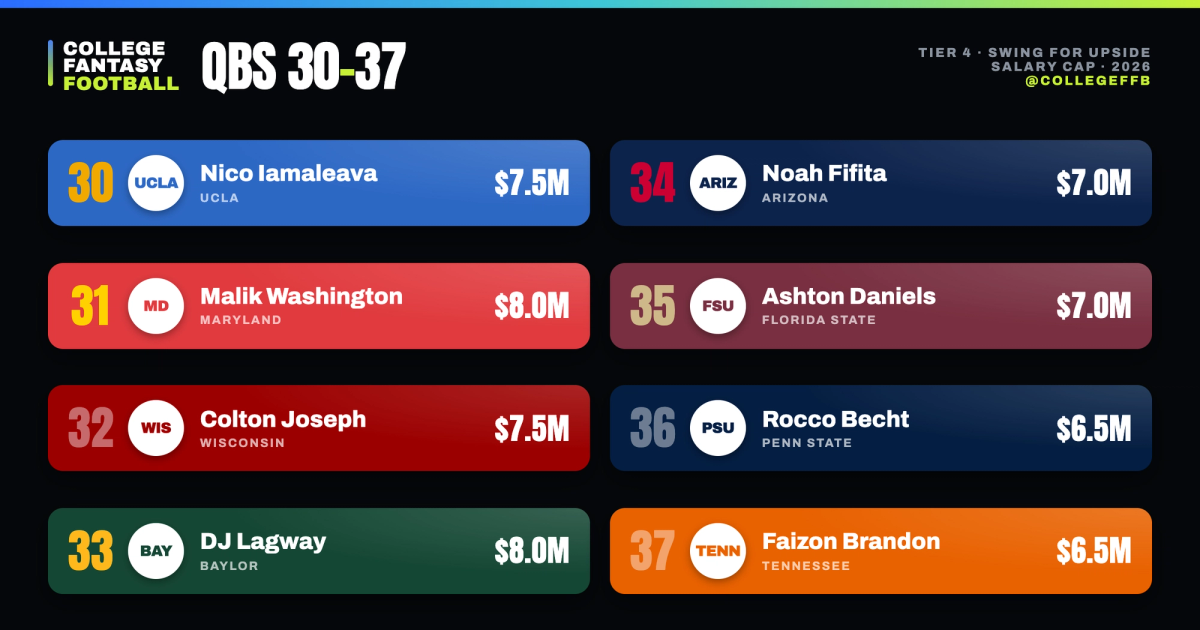
30. Nico Iamaleava, UCLA ($7.5M). The passing was ordinary in his first UCLA year (1,928 yards, 13 touchdowns), but he ran for 505 and 4, and in this format that keeps him afloat even in bad weeks. He announced his return before new coach Bob Chesney arrived. Volatile, but the legs give him a floor most guys at this price don't have.
31. Malik Washington, Maryland ($8.0M). Historic true freshman year: 2,963 yards and 17 touchdowns, both Maryland freshman records, plus 302 rushing yards and 4 scores, making him one of only two Big Ten true freshmen since 1996 to clear 2,500 passing and 300 rushing. He's 6-5, 231 with maybe the best arm in the conference, and new coordinator Clint Trickett is expected to use his legs more. The team was 4-8, so the wins won't come easy, but the volume and the arrow both point up.
32. Colton Joseph, Wisconsin ($7.5M). My favorite swing in this tier. At Old Dominion, Joseph put up 2,624 passing and 1,007 rushing with 34 total touchdowns and won Sun Belt Offensive Player of the Year. Here's the number that matters: per PFF, 920 of those rushing yards came on designed runs, not scrambles. That means the rushing volume is baked into how he plays, not luck. He's one of only five FBS quarterbacks to hit 1,000 rushing yards. The risk is the jump to the Big Ten and a Wisconsin program that has famously never featured a running quarterback. High-risk, high-reward, and the reward is exactly the rushing profile this format prizes.
33. DJ Lagway, Baylor ($8.0M). The talent is undeniable, the fantasy profile is not what people assume. Lagway was the No. 1 dual-threat recruit in his class, but injuries (shoulder, sports hernia, calf) have held him to 237 rushing yards and one score across his entire career. His 2025 was a mess: 2,264 yards, 16 touchdowns, 14 picks, on a 4-8 Florida team that fired its coach midseason. Baylor is a soft landing, with Jake Spavital calling plays after coaching Sawyer Robertson to second nationally in passing yards. You're buying a passing rebound and a fresh start, not a rushing floor.
34. Noah Fifita, Arizona ($7.0M). The safest floor in this tier. Fifita set Arizona's single-season record with 29 touchdowns against just 6 picks, threw for 3,228, and became the first Wildcat to make first-team All-Big 12 in fifty years. He returns for a final year with the same coach and coordinator. The catch is he's undersized and barely runs, so it's passing production or nothing. But 29 touchdown passes at $7.0M is a genuine value if you need arm points.
35. Ashton Daniels, Florida State ($7.0M). Named FSU's starter in April. He's a real runner, 1,397 career rushing yards and 11 scores across Stanford and Auburn, including 669 and 3 in his last full season as a starter. Two flags: he's 5-18 as a college starter, and he's thrown 24 touchdowns to 22 picks for his career. Mike Norvell takes back playcalling and FSU added Texas transfer back Quintrevion Wisner. The rushing keeps him startable; the accuracy and the record are why he's a bench guy.
36. Rocco Becht, Penn State ($6.5M). A steal if the shoulder's right. Becht has 9,274 career passing yards and 64 touchdowns, and he quietly ran for eight scores in each of his healthy Iowa State seasons, so the goal-line equity is there. A shoulder injury dragged his 2025 down to 16 touchdowns and led to labrum surgery, but he follows head coach Matt Campbell and his coordinator to Penn State, meaning familiar system, much better weapons. Veteran, proven, healthy again, and priced at $6.5M. That's the definition of this tier.
37. Faizon Brandon, Tennessee ($6.5M). The Heupel-system lottery ticket. Brandon is a five-star true freshman, the No. 3 quarterback in his class, who went 35-1 in high school with a rocket arm and real rushing production. He's the reported leader to start Week 1. The reason he's worth a dart at $6.5M is the offense: Josh Heupel's up-tempo system produces huge counting stats for whoever plays quarterback, freshman or not. The flags are obvious, true freshman, job not fully locked, SEC defenses, but if he wins it, the system gives him a top-fifteen ceiling.
Tier 5: Lottery Tickets (Nos. 38-50)
The bottom of the board, $6M to $7.5M. Two of these are better than lottery tickets, and two are priced above what the tape supports.
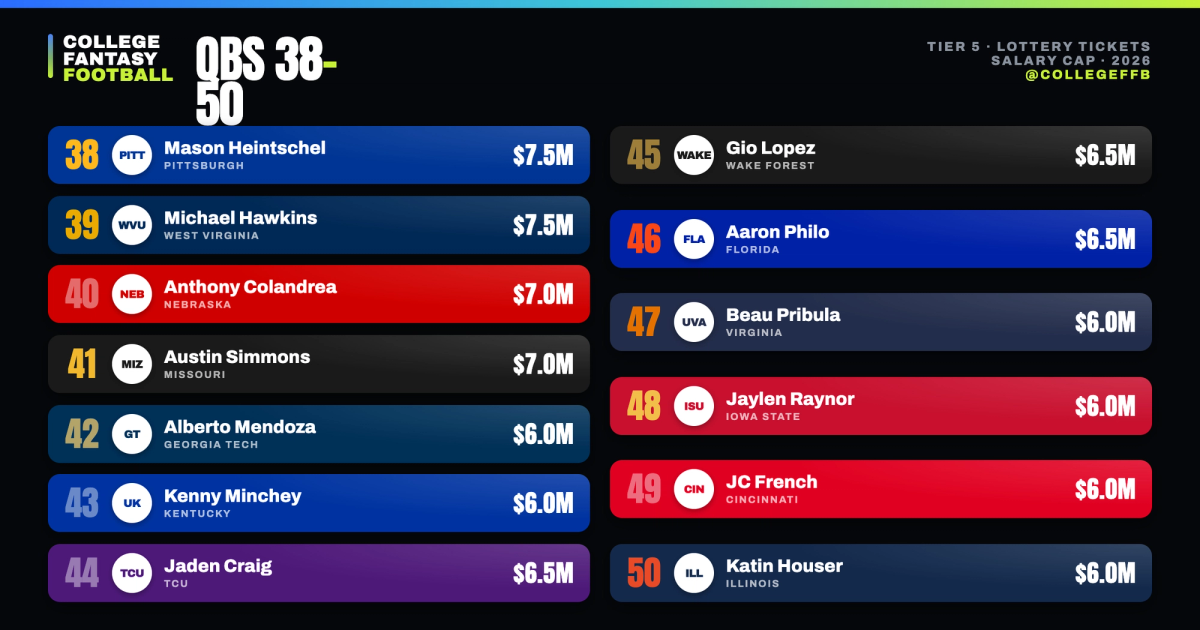
38. Mason Heintschel, Pittsburgh ($7.5M). Real talent, wrong price for this format. Heintschel threw for 2,354 and 16 as a true freshman and became the first Power 4 freshman to hit 400 yards in a game in 2025. But he's not a runner (88 net rushing yards, 2 scores), he hit a visible freshman wall over his final four starts, and Pitt's receiving corps is almost entirely new. Good player, and $7.5M buys more elsewhere on this list.
39. Michael Hawkins, West Virginia ($7.5M). The pitch is Rich Rodriguez's quarterback-run offense and the fact that WVU threw for 10 touchdowns to 11 picks as a team last year, so the job is wide open in the best way. The problem is the résumé: 950 career passing yards and 5 starts across two years as an Oklahoma backup, plus 374 rushing yards and 2 scores. Four-star pedigree, real mobility, near-zero production. That's a lot to pay at $7.5M.
40. Anthony Colandrea, Nebraska ($7.0M). The best value on the entire back half of this board. Colandrea was the Mountain West Offensive Player of the Year at UNLV, throwing for 3,459 and 23 and running for 649 and 10 touchdowns, 33 total scores. PFF ranks him the No. 3 returning quarterback in the Big Ten behind only Sayin and Moore. He's 31 games and three seasons into his career, he's been named Nebraska's starter, and the Huskers just lost a 1,451-yard back, so his legs will matter even more. The one flag is turnovers, 29 career picks. At $7.0M, this should be your first call in the endgame.
41. Austin Simmons, Missouri ($7.0M). Named the starter in March. The 2025 sample is thin and unimpressive (744 yards, 4 touchdowns, 5 picks in an injury-wrecked year at Ole Miss, plus 71 rushing yards) but it's worth remembering he opened that season as the starter over Trinidad Chambliss before an ankle injury flipped the job. He's a former four-star who reclassified up two years. Missouri also lost five of seven receivers who caught a pass last season. Talent bet, murky supporting cast.
42. Alberto Mendoza, Georgia Tech ($6.0M). The bloodline dart. Fernando's younger brother went 18-of-24 for 286 and 5 touchdowns in mop-up duty at Indiana and added 190 rushing yards, and he's the favorite to start at Georgia Tech, a program that just turned Haynes King into ACC Player of the Year with a quarterback-friendly, run-heavy system. The appeal is the fit and the rushing element; the flags are that he's replacing an award winner with almost no real snaps, and the coordinator who built that system left for Florida. At $6.0M, a fine end-of-bench swing.
43. Kenny Minchey, Kentucky ($6.0M). The system bet, and the system is the whole pitch. Minchey was a career backup at Notre Dame with barely any starts, but he was just named the starter at SEC Media Days by first-year Kentucky coach Will Stein, who as Oregon's coordinator developed Bo Nix, Dillon Gabriel, and Dante Moore into 70-percent passers in a high-scoring offense. Minchey is a dual-threat with 2 career rushing scores on 9 carries. You're not buying his résumé, you're buying Stein's track record with quarterbacks. At $6.0M, that's a bet worth making.
44. Jaden Craig, TCU ($6.5M). Massive FCS production at Harvard, over 6,000 yards and 52 touchdowns, plus an Ivy title and an FCS playoff berth. He's unproven at the FBS level and was not much of a rushing threat in that offense. Good size, smart player, sensible fit in the TCU system. A pure projection.
45. Gio Lopez, Wake Forest ($6.5M). Ignore the 2025 line and look at 2024. At South Alabama he threw for 2,559 and 18 and ran for 465 and 7. Then he went to North Carolina for Bill Belichick's first year and the whole offense cratered, leaving him at 1,747 and 10 with 133 rushing yards. Now he reunites with Rob Ezell, his South Alabama offensive coordinator, at Wake Forest. If the version that ran for 465 shows up, this is a steal at $6.5M.
46. Aaron Philo, Florida ($6.5M). All projection, but interesting projection. Philo has thrown 102 career passes for 938 yards at 9.2 per attempt with elite PFF grades in tiny samples, including the top overall quarterback grade in the country in a Week 13 game in 2024. He follows Buster Faulkner to Florida, and Faulkner's Georgia Tech offenses never averaged under 28.9 points, while Napier's Florida ranked 111th in scoring. Faulkner also used quarterbacks in the run game. The flag: Philo has not won the job yet, and he's competing with Tramell Jones.
47. Beau Pribula, Virginia ($6.0M). Better than a lottery ticket. Officially named Virginia's starter, Pribula ran for 297 and 6 touchdowns last year at Missouri to go with 1,941 passing yards and a 67.4 percent completion rate, third-best in the SEC, and he did it in only 10 games before an ankle injury. Seven of his nine picks came against SEC defenses. Now he steps into a Virginia team that won a program-record 11 games and reached the ACC title game. Rushing scores plus a good team at $6.0M is a nice endgame combination.
48. Jaylen Raynor, Iowa State ($6.0M). Three-year starter who led the Sun Belt in completions and passing yards in 2025 with 3,361 and 19, and ran for 423 and 7 more. That's 26 total scores, and he follows his longtime coordinator Keith Heckendorf to Ames. The caution is the environment: Iowa State lost 16 starters to the portal after the coaching change, more than any team in the country, and Raynor threw 11 picks last year. Production is real, roster around him is not.
49. JC French, Cincinnati ($6.0M). Georgia Southern's all-time leading passer, coming off 2,929 and 20 with only 8 picks, plus 315 rushing yards and 6 rushing touchdowns. He steps behind one of the best offensive lines in the country, since Cincinnati allowed just eight sacks all of 2025, second-fewest in FBS. The scouting consensus is high floor, low ceiling: he doesn't push the ball downfield much. For a bench quarterback at $6.0M, floor plus six goal-line runs is fine.
50. Katin Houser, Illinois ($6.0M). Houser threw for 3,300 and 19 with only 6 picks at East Carolina and added 9 rushing touchdowns as a designated goal-line runner. That's 28 total scores. He also had 24 "big-time throws" per PFF, tied for third nationally, and he's the clear frontrunner to replace Luke Altmyer at Illinois, a program with 19 wins over the last two years. The knock is consistency, since his QBR swung wildly at ECU. If you’re taking the swing here it is because Illinois has quietly been a very solid program the past two years, and $6.0M is nothing for a starting QB on a good team.
How to use this
It's a salary cap game, so every decision comes with a tradeoff.
The elites are all but guaranteed to produce. Go that route and you're pinching pennies everywhere else.
The budget options can blow up in your face and leave a goose egg at the top of your scoreboard while your buddy gets 45 out of his.
The mid tier is where it gets really interesting. An $8M option that gives you $12M production is what moves you up the rankings. An $8M option that plays like a $5M one leaves you wishing you hadn't been so cheap.
That's the fun of this format. There isn't one right answer. Every path is viable, you just have to get it right.
So what are you waiting for? Pick your team today.