Best Flex Options for College Fantasy Football in 2026
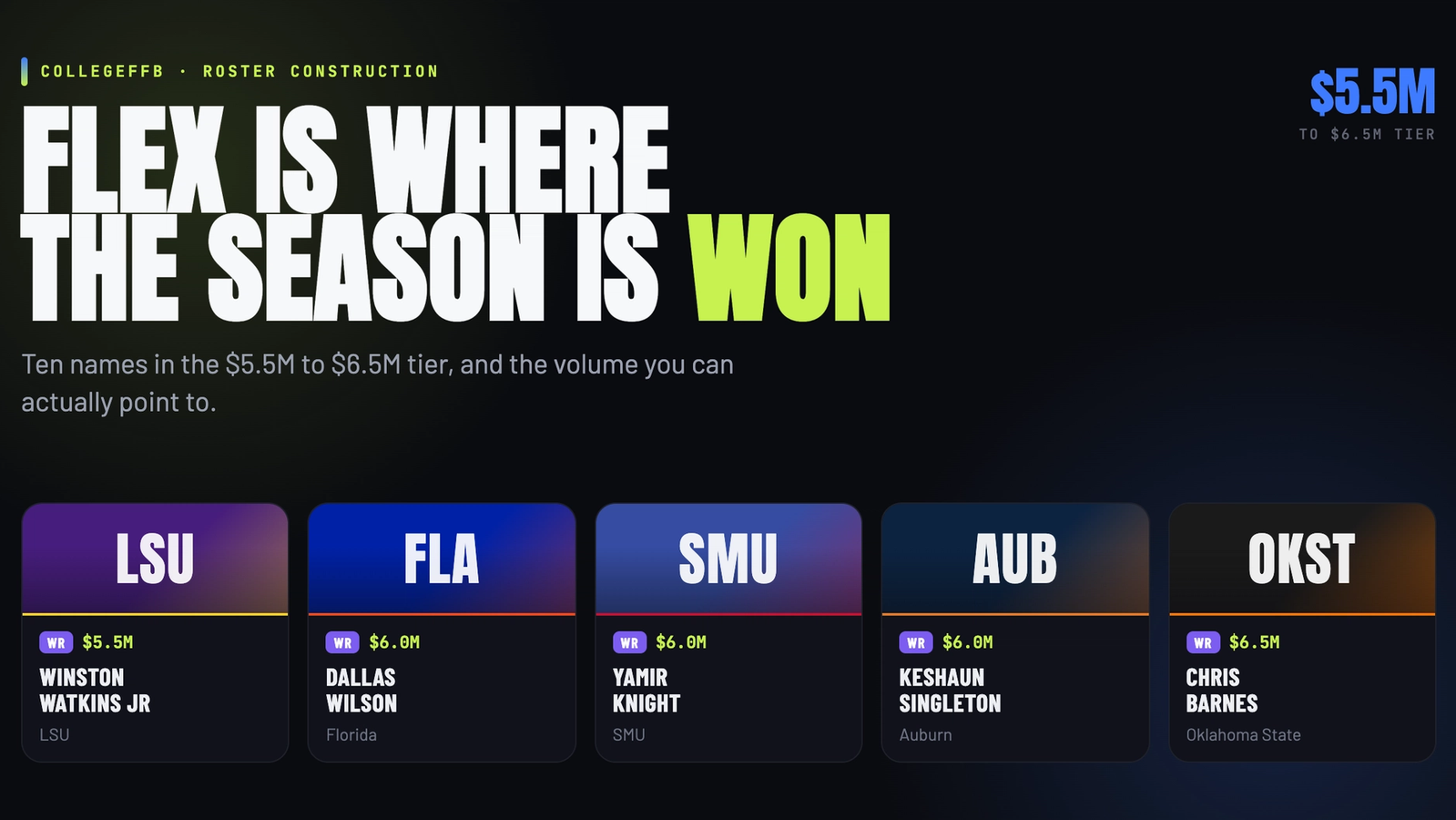
Most people lose their season at the top of the roster. They spend on the names they know, then fill the flex with whatever is left and hope.
The flex spot is where salary cap leagues are actually won, for two reasons. The first is arithmetic. Every dollar you save at flex is a dollar you spend on a back who touches the ball 25 times a week, so the cheap slot decides what the expensive part of your roster can look like.
The second reason arguably matters more. In leaderboard scoring, it’s not just about scoring more points than your buddy who has never played before. You are trying to score more points than everyone else in the global competition, and you cannot do that with just the players everyone else has. More than 30% of teams are starting Jeremiah Smith. Owning him provides a safe floor, but it’s not the piece of your roster that differentiates you from the pack. Most of the guys below are owned in the low single digits. That is where your rank actually changes the most.
What the flex spot is in CollegeFFB
CollegeFFB uses a salary cap format rather than a draft. Everyone has access to every player, and everyone is working from the same budget. Your flex can be a running back, a wide receiver or a tight end, which means it is the one spot on the roster where you are comparing players across positions instead of within them.
That flexibility is the whole point. It also makes the flex the easiest place to overspend, because a good player at any position technically qualifies.
How to think about flex value
The mistake is treating flex like a fourth starter you need to win. It isn't. It's a math problem.
A useful target: build the roster so at least one flex spot holds a $7 to $7.5 option, then fill the other with someone in the $5.5 to $6.5 range who has a defined path to volume. That combination is usually cheaper than two mid-priced guys and produces more points, because the cheap slot is where breakouts live.
What you are looking for in that cheaper slot is not upside in the abstract. It's opportunity you can point to. A receiver whose team lost four of its top five pass catchers. A back whose team returned him and lost nobody. A transfer who followed his coordinator and already knows the playbook. Those are knowable things in August. Talent is not.
Below are the options I keep landing on. No matter how I build the roster, one or two of these end up starting.
The $5.5M tier
Winston Watkins Jr, WR, LSU
Watkins caught 26 passes for 373 yards as a true freshman at Ole Miss, then followed Lane Kiffin to Baton Rouge in the portal. He projects as the slot receiver with Sam Leavitt throwing, and Kiffin slot receivers have historically had a reliable floor.
The risk is competition. LSU signed a large group of portal receivers, so nothing about the target share is settled. Early reports out of camp have him as the WR1, which is a bet I am willing to take for just $5.5M.
JoJo Trader, WR, NC State
A former top-100 recruit who never broke out of Miami's receiver rotation, finishing last season with 13 catches for 178 yards. He transferred to NC State and is now catching passes from CJ Bailey, his high school teammate at Chaminade-Madonna.
Dave Doeren rebuilt the receiver room around Bailey this offseason. Trader has the highest ceiling in it and the longest relationship with the quarterback.
Jeremiah Cobb, RB, Auburn
Cobb ran for 969 yards on 175 carries last season and earned third team All-SEC, then returned for his senior year rather than transferring. He spent the offseason deliberately adding weight to handle a heavier workload in Alex Golesh's tempo offense.
The reason he is priced here and not at 7.0: Byrum Brown. Brown is transferring over from USF and bringing all of his tremendous rushing upside with him. Biggest concern is that Brown vultures a ton of goalline TDs from Cobb.
Demon June, RB, North Carolina
June led North Carolina in rushing as a true freshman with 464 yards, and added 17 catches for 159 yards, which matters in a PPR format. Bobby Petrino is calling plays now, and June has publicly said the plan is to run downhill rather than sideways.
There are bodies in that backfield, so committee risk is genuine. He is on the Doak Walker preseason watch list, which suggests the staff sees him as the lead.
The $6.0M tier
Dallas Wilson, WR, Florida
Wilson caught six passes for 111 yards and two touchdowns in his first career start against Texas as a true freshman, setting multiple Florida freshman records, then lost the rest of his season to a foot injury. He finished with 12 catches for 174 yards and three scores in four games.
The talent question is answered. The health question and the Aaron Philo versus Tramell Jones quarterback competition are not.
You are buying here is you think Wilson will be the WR1 on a revamped Florida team.
Yamir Knight, WR, SMU
Knight caught 54 passes for 637 yards while finishing third on the team, and SMU lost its first, second, fourth and fifth leading receivers this offseason. Quarterback Kevin Jennings named him unprompted as his breakout pick for 2026.
This is about as clean a path to WR1 volume as exists at this price point. He also returns punts, which adds a scoring path in formats that count it.
Keshaun Singleton, WR, Auburn
Singleton caught 50 passes for 877 yards and eight touchdowns at USF, then followed Golesh, his position coach Kodi Burns and his quarterback Byrum Brown to Auburn. The entire Auburn receiver room turned over, so he arrived as WR1 without competing for it.
A 6-3 target catching passes from a quarterback he has three years of reps with, in an offense he already knows. That is a lot of certainty for 6.0.
The $6.5M tier
Chris Barnes, WR, Oklahoma State
Barnes caught 39 passes for 547 yards and added 143 rushing yards on 13 carries at Wake Forest, earning All-ACC honorable mention as a redshirt freshman. He transferred to Oklahoma State, where Eric Morris runs an air raid system that has always fed smaller slot receivers.
His quarterback is Drew Mestemaker, who led FBS in passing yards at North Texas last season. Barnes is also on the Jet Award watch list as a returner. The volume projection here is the most aggressive on this list.
Isaiah Horton, WR, Texas A&M
Horton led Alabama in receiving touchdowns with eight on just 42 catches, then transferred to Texas A&M. At 6-4 he is a red zone problem, and the Aggies have to replace KC Concepcion's production.
He is touchdown dependent, which makes him volatile week to week. That is an acceptable trade at flex, where you need points more than you need consistency.
Braden Pegan, WR, Utah
Pegan caught 60 passes for 926 yards at Utah State and earned first team All-Mountain West, then followed offensive coordinator Kevin McGiven to Utah. He is on the Biletnikoff preseason watch list, the first Utah player named to it since 2017.
Utah's receiver room is crowded, but he is the only one in it who has produced at a starting level, and he already knows the system.
Final Thoughts
These are the guys that make it possible to roster your favorite running back and your favorite receiver on the same team. Everyone would love a lineup of Jeremiah Smiths and Kewan Lacys, but that would make the game boring, and it would make the leaderboard a coin flip.
Check out the list. Check out your school's depth chart. Get creative with roster construction.
Flex hunting is one of the best parts of college fantasy football, and there is no shortage of viable options.